Bennie Milliner has renewed hope for heart with tiny new pacemaker
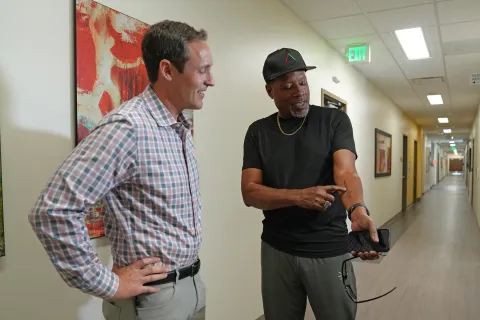
Bennie Milliner’s heart has been through a lot. Over the past quarter-century, he’s had a heart attack, congestive heart failure, stents placed in blocked arteries, chronic chest pain, fainting episodes and irregular heart pauses of up to 10 seconds.
Thanks to the medical teams at Denver Health’s Cardiology unit, his latest procedure, the installation of a new type of pacemaker, isn’t weighing heavily on his heart.
Milliner received a leadless pacemaker, a one-piece device smaller than a AAA battery and less than one-tenth the size of a traditional pacemaker.
“I feel the increase in stamina every day,” Milliner said of his health just two weeks after the minimally invasive procedure last month. “I want to get back to full workouts, and we'll see how it goes, but I think it's going to be OK, because I can feel it already.”
Heart History
Milliner’s heart issues started in 2001 when he ended up in the emergency room of an Aurora hospital. He had stents placed into his arteries, which lasted until a day he will never forget: Feb. 12, 2018.
On that day, Milliner suffered a massive heart attack and was brought to Denver Health, where his heart stopped beating for 30 minutes before he was revived. He had an out-of-body experience during the time, which he described as “so peaceful” and “absolutely incredible.”
“And then I heard somebody say, ‘We’ve got a pulse.’”
He underwent emergency heart surgery with stents placed in his arteries. Follow-up echocardiograms revealed a weakened heart muscle, a condition known as congestive heart failure, and he later experienced recurring chest pain tied to chronic artery blockages. He received additional stents in 2020 and 2021 and has been treated with medication since. Despite progress, Milliner began fainting in 2022. Doctors implanted a tiny heart monitor and discovered dangerous electrical pauses, sometimes up to 10 seconds.
Milliner was hesitant to get a pacemaker, particularly the traditional kind, which can leave a visible lump and scar. But Denver Health cardiologist and electrophysiologist Christopher Barrett, MD, told Milliner about the newer, leadless version, which is completely self-contained in the heart, ensures his heart won’t slow down or stop, and has a battery that lasts more than 10 years.
Following the installation of the device, Milliner is feeling better every day.
“I think (Milliner) highlights the fact that here at Denver Health, we’ve got a great multidisciplinary team,” Barrett said. “And I think he’s gotten the benefit of that kind of multidisciplinary approach.”
Milliner is focused on regaining strength and moving on with life. He’s grateful for the care he has received and the staff, who are more like friends now.
“The service, the facilities, the staff are first class,” Milliner said.
Milliner was so moved by the care he received following his near-death experience in 2018 that he got a tattoo on his left arm. It reads, “2.12.18 2nd Chance,” with a heartbeat line leading to a blue and orange Denver Health heart.