July 05, 2026
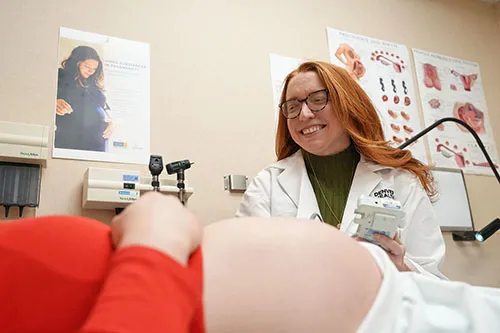
For pregnant patients with a substance use disorder, the path to getting help can feel like a maze, one navigated under extreme stress and without much guidance along the way.
There’s one clinic for prenatal care, another for substance use treatment and another for behavioral health. Add transportation, stigma and fear, and too many patients never get the help they need.
Denver Health’s Obstetrics and Gynecology and Family Medicine teams started the OB Perinatal Addiction and Recovery program, known as OB PEAR, to change that.
“We created this program so that hopefully we could break down barriers for patients affected by substance use disorder in pregnancy and be able to provide them wraparound care at Denver Health,” said Kylie Culp, MD, an OB/GYN generalist and medical director of OB PEAR.
The program integrates substance use screening, treatment, counseling, social work, behavioral health and community support into routine prenatal and postpartum care. That means patients can receive care in one place, often at a clinic close to home, instead of trying to piece it together on their own.
Culp said OB/GYNs and family medicine physicians are experienced with treating diabetes or hypertension in pregnancy. Substance use disorder should be treated the same way, as a medical condition.
“This is a treatable disorder,” Culp said. “We can help people.”
Care at the bedside, in the community
Stefka Fabbri, MD, chair of OB/GYN at Denver Health, said the program started with a hard look at maternal deaths in Colorado and across the country. Unintentional drug overdoses and untreated behavioral health conditions are among the leading causes of maternal deaths, and many of them happen after a patient has been seen by a doctor.
“For many years, this care remained fragmented,” Fabbri said. “And for this vulnerable patient population, this fragmented care has remained a huge barrier to getting the resources and the support that they need.”
She said that stigma, bias and criminalization associated with treatment of substance use disorders have made patients reluctant to engage with healthcare systems in the past. Through education, training of staff and partnerships in the community, things are changing.
At Denver Health, every patient will be treated with dignity and offered the same care, regardless of where they enter the system.
Patient Lezlie Woodson said OB PEAR “has been there every step of the way,” helping her find resources, prepare for appointments and grow in her recovery.
National model for care
Denver Health, which delivers one-third of all babies born in Denver and serves as the city’s safety-net hospital, was recently celebrated by America’s Essential Hospitals during its annual VITAL2026 conference, in Minneapolis.
America’s Essential Hospitals presented Denver Health the 2026 Gage Award for Quality Improvement in June, recognizing the program as a national model for “improving healthcare quality, population health and operational excellence.”
Since OB PEAR started about three years ago, roughly 97% of patients who screened positive for a substance use disorder have been connected with treatment.