
November 10, 2026
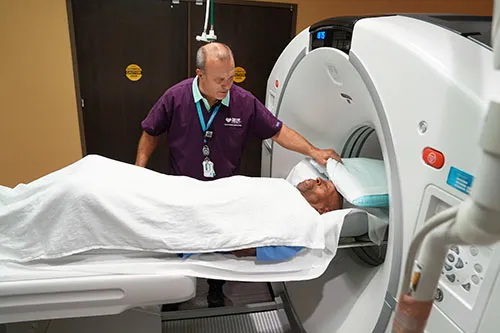
Jerry Hall has been living with prostate cancer for more than a decade. When the numbers his doctors were monitoring showed a troubling uptick, the 84-year-old needed to know if the cancer was spreading.
On Oct. 30, Hall became the first patient at Denver Health to undergo a new type of imaging that can detect prostate cancer in places traditional scans might miss.
The results brought welcome news that his cancer had not spread.
Seeing what other scans can’t
The new technology, PSMA PET/CT, gives physicians a more detailed picture of prostate cancer, helping them determine whether it has spread beyond the prostate or returned after treatment.
It works by injecting a small amount of radioactive material into the bloodstream that seeks out a protein commonly found on prostate cancer cells, like a spotlight to illuminate cancer that might otherwise go unnoticed.
The scan can identify cancer in lymph nodes, bones and other parts of the body, even when conventional imaging shows nothing suspicious.
That information can help doctors make more informed treatment decisions, whether a patient has just been diagnosed or has been fighting the disease for years.
“The more clearly and precisely we can see where disease is, the better we can determine how to treat it. This technology gives us a much more specific picture for prostate cancer, helping us make more informed decisions for our patients,” said Ashesh Thaker, MD, chair of Radiology.
Compassionate care
Bringing the technology in-house means patients can receive advanced imaging without leaving the Denver Health system, making it easier for Radiology, Urology and cancer care teams to coordinate treatment.
For Hall, who receives primary care at Denver Health's Sloan's Lake clinic and sees several specialists throughout the health system, the experience couldn't have gone much better.
“I felt very comfortable. I didn't feel rushed,” he said. “They provided me with warm blankets, which I needed very much at that particular time. … They're just very, very compassionate with me, and they catered to my needs.”
Hall's doctors will continue monitoring his cancer in the coming months. At least for now, the first patient to benefit from Denver Health's newest imaging technology found relief in what the scan didn’t find.
Lowry clinic expansion
The Department of Radiology this year expanded ultrasound hours of operation at the Lowry Family Health Center to four days a week. Patients can get same-day or next-day access for breast screening appointments on Wednesdays and Thursdays, as well as same-day walk-in access for X-rays Tuesdays through Fridays.
Talk to your doctor or contact the Appointment Center to schedule care.
