July 13, 2026

Charlotte Olsen suddenly couldn’t speak. She couldn’t text. She could hear what her colleagues were saying, but for nearly an hour, she lost the ability to communicate at all.
For someone who had spent her career preparing for emergencies, she was wholly unprepared for the possibility of a stroke at just 40 years old.
It was a chilly, snowy day in November 2024, and Olsen, who was working in Denver as an emergency management specialist for the U.S. government Health and Human Services, thought she was “just” having a panic attack. When her speech slowly began to return, she called a friend, a physician assistant, who told her she needed to go straight to the hospital.
Olsen trusted Denver Health in that moment. The mother of two had delivered her children there in 2014 and 2016, and her family has received care at Denver Health ever since.
Upon arriving at Denver Health’s Emergency Department, a team of doctors and nurses quickly made Olsen feel safe. After tests, including an MRI, she got the news that she’d had a stroke.
“It was a huge shock,” said Olsen. “I didn’t really expect that at my age.”
Because Olsen’s symptoms had been resolved before she arrived at the hospital, she didn’t need emergency treatment to stop it. But her care continued through the night, including blood work, monitoring and a full-body ultrasound to look for other clots.
What stood out about her hospital stay was not only the medical response, but the way people treated her during one of the scariest moments of her life.
“All of the doctors were just so kind,” she said. “It’s such a nice thing when you’re having a medical situation that is very uncertain.”
Denver Health was recently certified by DNV as a Primary Stroke Center. The certification recognizes Denver Health’s ability to provide exceptional stroke care for patients, including emergency evaluation, brain imaging, treatment, monitoring and follow-up care.
“As Denver’s primary safety-net hospital, we are proud to provide our community with rapid, expert care for stroke and other neurologic emergencies,” said Dave Jeon, MD, stroke medical director at Denver Health. “Every second matters, and patients who come to Denver Health can trust that our trained teams will evaluate stroke symptoms quickly and provide the best care possible.”
A Change of Heart
The cause of the stroke was traced to a congenital heart defect called a patent foramen ovale, a small hole in the heart present in about a quarter of the world’s population, though it's usually harmless and most people never experience symptoms.
Olsen initially was referred to another hospital for specialty care with a neurologist and a cardiologist. But after meeting with doctors elsewhere, she decided to come back to see the specialists at Denver Health.
“It is ultimately about me feeling comfortable and cared for and having trust in the providers here,” she said. “I just felt like they actually cared.”
Olsen returned to Denver Health for neurology care and had a successful procedure to close the hole in her heart.
A Stroke of Luck
Olsen had chronic migraines for about eight months after her stroke, but they eventually went away, and she no longer needs to see a neurologist or cardiologist.
And in late 2025, along with a good bill of health, a bit of good fortune finally came Olsen’s way.
It started when she was laid off as part of widespread federal job cuts.
“It’s probably the best thing that could have happened,” she said with hindsight.
Without losing her federal job, where she had worked for five years, she wouldn’t have been looking for a new job, and she wouldn’t have found a fresh start at the place nearest to her heart.
When she saw a job posting for an emergency management planner on Denver Health’s careers website, she just knew.
“I was like, ‘Oh, that's my job. That's the job I'm going to get, because I believe in the mission of Denver Health,” Olsen said.
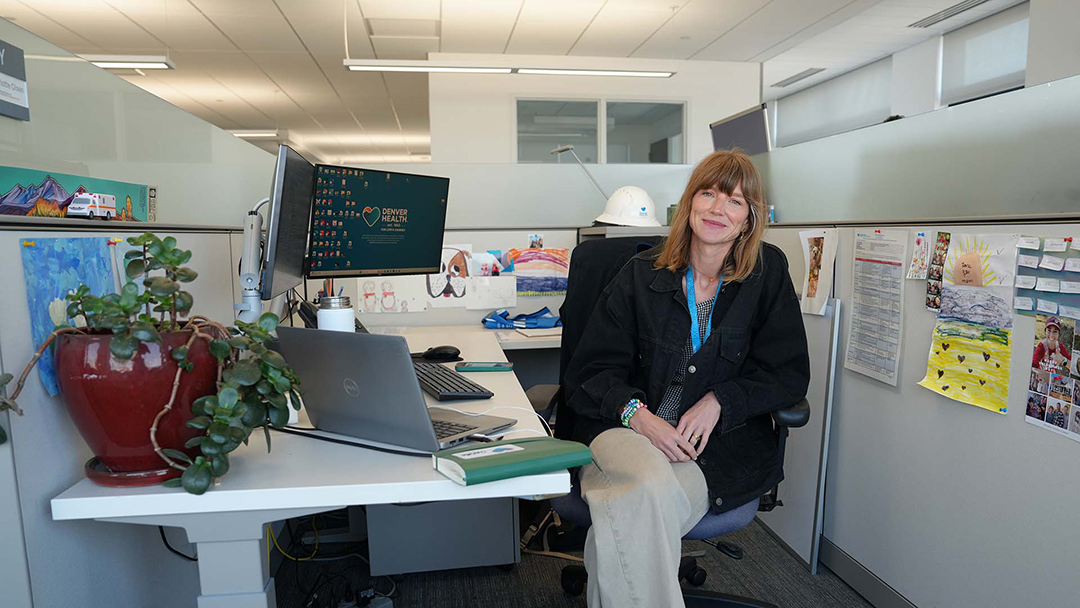
Today, Olsen is doing well and enjoying the latest chapter in her career journey at a place she feels at home. In her role, she develops strategies to help Denver Health prepare for, mitigate, respond to and recover from potential disasters, big and small.
Her work is critical to keeping patients and staff safe at Colorado’s most trusted healthcare provider and Denver’s safety-net health system, which provides high-quality care to all in the community, regardless of ability to pay.
“I feel like it's a privilege to work here and also be a patient here,” Olsen said. “I get this exceptional care, and everybody else does, too.”