November 25, 2026
By Jessica Churchill, MD
I'm Dr. Jessica Churchill and I am one of the shoulder and elbow surgeons here at the Denver Health Orthopedic Center of Excellence. This article is going to give you everything you need to know about common shoulder injuries, including rotator cuff, dislocation and arthritis. You will find out what causes shoulder injuries, when you might need to see a doctor, the best treatment for common shoulder injuries and when it's time to consider having surgery.
Three main categories of shoulder injuries
I like to think about shoulder injuries in these three main categories:
- Impingement or rotator cuff
- Instability or dislocation
- Arthritis or rotator cuff arthropathy
The location of the pain in your shoulder is one of the primary things that indicates which type of shoulder injury you are dealing with.
How do I know if I have a rotator cuff injury?
For the first category, impingement or rotator cuff type pain, it's really common for you to have pain more on the lateral side of your deltoid, or on the outside of your arm. So if you have aching or pain in your deltoid area, especially when you raise your arm, go across your body, or try to do anything above shoulder level, it's common that that's an impingement-type or a rotator cuff injury.
Sports and activities that cause rotator cuff injuries (pickleball, tennis)
There are certain sports that lend themselves to those injuries, such as racket sports, including pickleball, tennis, or anything you're doing an overhand or a backhand/forehand-type motion where that shoulder joint is rotating around or raising up. It can be painful. You also can have injuries to your rotator cuff that come from a sudden movement during common everyday activities, like shutting a car door too quickly or reaching in behind you to get your purse in the back of the car and you feel kind of a pop or a jolt in your shoulder.
What are the most common symptoms of a rotator cuff injury?
There are three common symptoms of pain that tell you you're dealing with a rotator cuff injury:
- Pain on that outer side of the arm
- Pain that's worse at night
- Pain that's worse when you elevate your arm or move it across your body
It's important to understand that you don't need surgery for every rotator cuff or impingement injury. A lot of times we can take care of those pains through physical therapy or cortisone injections. But occasionally people do need to go on to have surgery. If your rotator cuff is torn, it is important that we see you quickly, because once the rotator cuff is torn, the muscles attached to that tendon don't have a job and your body actually resorbs that muscle and it makes it very hard or impossible for us to repair it. So if you have any constellation of symptoms that's similar to that, it's important that you either talk to your primary care doctor about getting some imaging or come and see one of us in sports medicine at Denver Health Orthopedics, so that we can work you up and see what's bothering you.
How do I know if I have a shoulder dislocation?
For the second category of injuries, instability or dislocation, this is where you have injuries where you dislocate your shoulder or you subluxed or almost dislocated your shoulder, but it doesn't come completely out of the socket. Some people are a little bit more "stretchy" or flexible, and if that describes you, you might have multidirectional instability, in which case you're just a very flexible person and your shoulder joint moves around more than is healthy. A lot of times that can be fixed with physical therapy to strengthen the surrounding muscles and stabilize the shoulder. But if you're somebody who has actual dislocations where you potentially have to go to the emergency room to have that shoulder put back in place, then it's really important that you come see us so we can talk about your options.
Sometimes if you have only one or two dislocations, we can still treat those without surgery with strengthening physical therapy. But if you have someone who's had multiple dislocations or someone who dislocates and puts their shoulder back in themselves, a lot of times surgery is necessary to fix that problem. Most of those surgeries can be done through the arthroscope or through small incisions with a small camera. The goal there is to stabilize your shoulder so that it stays in the socket.
What are the most common causes and symptoms of shoulder dislocation?
A lot of instability patients have a vague pain in the front and the back of the shoulder, depending on which way they're unstable, but their most common presenting symptom is actually the dislocations that happen to them. Sometimes it's with sports such as snowboarding, volleyball or pickleball. Other times, people just dislocate when they're sleeping or when they're reaching and doing everyday tasks. If you are one of those people, it's really important that we stabilize your shoulder before there's too much damage in there from it dislocating out of the socket.
What causes shoulder arthritis?
For the third category, shoulder arthritis, or what we call rotator cuff arthropathy, you can develop arthritis in your shoulder, that is what we call primary osteoarthritis, where your rotator cuff is intact; you just develop arthritis within the shoulder joint, which is a wearing down of the cartilage and a remodeling of the bone in your shoulder. In those cases, when you have an intact rotator cuff, a lot of what people notice is that they still have strength but they're very, very stiff. They can only lift their arm partway, or mostly they can't rotate out to the side, or what we call external rotation. They just feel like the shoulder pops and clicks and gets stuck. If you are one of those patients, we can treat your pain with cortisone injections if you're looking to avoid surgery, but the only real way to return that shoulder to function properly and decrease the pain permanently is to do what's called a shoulder replacement.
What is the difference between an anatomic vs. reverse shoulder replacement?
There are two types of shoulder replacements:
- Anatomic shoulder replacement
- Reverse total shoulder replacement
Let's start with anatomic. It's called anatomic because the replacement is put together the same way your shoulder is put together now, with the ball on your arm side and the socket on your shoulder blade side. We replace the ball with a smooth metal head and take away all the arthritis that you have in there, and we implant a small polyethylene or plastic piece, similar to Teflon, in the socket side so that that ball and socket can glide like it did initially when you had healthy and young cartilage.
The anatomic implant is wonderful because it lasts about 15 years, and you will able to go back to playing sports or doing whatever it is you love to do. You will be able to get full range of motion back in most cases, and do everything you did before you had arthritis. The key with that shoulder replacement is you do have to have a functioning rotator cuff. If you were to tear your rotator cuff down the road after getting the implant, we would need to take that implant out and put in the other type of shoulder replacement, which is called the reverse total shoulder replacement.
The reverse total shoulder replacement is really just a reversal of how the ball and socket is on the anatomic, and so we call it very creatively the reverse. We turn your arm side into the socket and we turn your socket on your shoulder blade side into the ball. We call it the glenosphere. So what that does is it biomechanically changes your shoulder so that you can lift your arm utilizing your big deltoid muscle on the side instead of those small muscles of the rotator cuff.
Who should get a reverse total shoulder replacement?
The reverse total shoulder replacement is especially helpful for people who have torn their rotator cuff and cannot get it fixed and are not eligible to get an anatomic total shoulder replacement. If that is you, you have something called rotator cuff arthropathy. And what that means is as your rotator cuff is torn and cannot be fixed, the actual ball of your socket drifts upward because your deltoid is pulling it up. That allows the shoulder to wear or develop arthritis more quickly than if you had an intact rotator cuff. So if you have pain and an inability to raise your arm because of both the arthritis and the rotator cuff, what we usually offer is either cortisone injections for pain and physical therapy to try to maintain the motion that you have, or if you've tried those things and you're no longer happy or you just wish to get a permanent fix, we do a reverse total shoulder replacement.
In my experience, those patients do really well. They have slightly less motion than an anatomic total shoulder, but they have the added benefit of not needing the rotator cuff in order to function with the implant. So if you had a further tear of your rotator cuff from another injury, we do not have to take that implant out. It works just as well without the rotator cuff.
When should I see a doctor for shoulder pain?
Altogether, shoulder injuries are pretty complex because the shoulder joint is wonderful in that it moves a great amount and you have a huge amount of motion with it, but it also makes it susceptible to injury and makes it very difficult to treat at times because it has so much motion. So if you've had an injury to your shoulder and you feel like it's not going away with the regular things you do for injuries, such as using an ice pack, taking anti-inflammatory medications and rest, then it's important that you go to get further imaging to see if something is wrong.
When we image the shoulder, X-rays show us what the bone looks like and an MRI shows us what the soft tissues in the rotator cuff look like. So your provider, either primary care or an orthopedic surgeon, will order one of those or both of those images to see what's going on and help with an exam to diagnose you with whatever might be happening in your shoulder.
What feels like shoulder pain but is actually neck pain?
One common thing that comes to me often that presents as shoulder pain, and is actually commonly not, is pain in the back of the shoulder blade. So pain all the way in the back of the shoulder blade and knots that lead up to your neck is most commonly neck pain and actually not shoulder pain. That being said, you can have that and other issues in your shoulder at the same time, and that's why it's important to come see one of us.
What happens at a doctor's appointment for shoulder pain (physical therapy referral)?
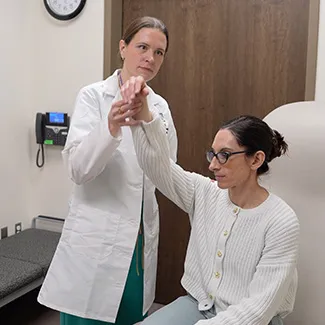
When you come in to see me with shoulder pain, after talking to you and doing an exam, for most shoulder injuries, the first step is to refer you to go get physical therapy. Most of us hunch over while we work on our computer or look at our phone, and we have some pretty bad posture with our shoulders. So a lot of times the place we start is getting your shoulders back and your chest wall open in order to make sure that you're using your shoulders in the best way. That can really decrease a your pain, loosen up the muscles in your neck, and make them overall very much more functional.
Shoulder injury treatment steps: physical therapy, cortisone injection, imaging and surgery
After physical therapy or during physical therapy, if you are not getting better, there are certain injuries where we'll offer a cortisone injection, an anti-inflammatory medication that's injected directly into the shoulder. The injection allows the medicine to stay in one location, kind of like putting an ibuprofen directly inside and it doesn't go to the rest of the body. Cortisone can really decrease inflammation and decrease pain and allow you to participate in physical therapy more fully and achieve better results. Cortisone injections can be done every three months if necessary, and a lot of patients need one or a couple of those in order to really get maximum benefit.
If you've tried both those things and we're still not seeing progress, a lot of times we then decide if surgery is right for you. There's a wide variety of surgeries you can do in the shoulder, and each one has various risks and benefits. Usually we try to maximize conservative care first, but if we do reach that surgical decision-making point, it's important that we talk together, patient and provider, and decide what the goals are and what expectations are realistic after a surgery or without a surgery in order to make that decision.
Call us and make an appointment. We'll figure out what's going on and get you back on track to doing what you love.