June 02, 2026
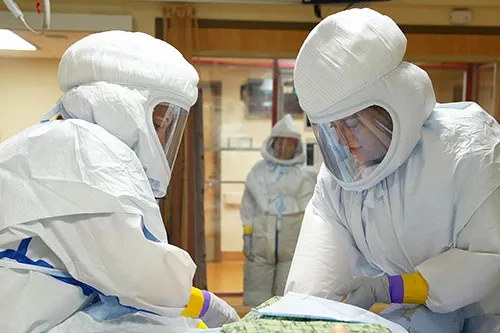
Long before a patient with Ebola would ever arrive in Colorado, Denver Health is preparing for one, continuing the research and training that’s expected from the trusted leader in the region for readiness and care for high-risk infectious diseases.
Denver Health is home to the Regional Emerging Special Pathogens Treatment Center, or RESPTC, and the High-risk Infection Team, known as the HITeam. Together, they make Denver Health the only regional treatment center for Ebola and other special pathogens in a six-state area that includes Colorado, Utah, Montana, Wyoming, North Dakota and South Dakota.
That role has taken on new importance as an Ebola outbreak caused by the Bundibugyo virus continues in the Democratic Republic of the Congo and Uganda. As of last week, there were more than 900 suspected cases and 119 suspected deaths in DRC, along with five confirmed cases and one confirmed death in Uganda. The U.S. Centers for Disease Control and Prevention has also increased traveler monitoring for people arriving from affected areas.
Denver Health is one of just 13 regional treatment centers in the country for Ebola and other special pathogens. It coordinates with public health departments, paramedics, federal partners, air medical transport partners and other agencies across the region whenever there is a potential threat and even when there’s not.
“Ebola is rare, but it requires a response that is practiced, coordinated and immediate,” said Heather Young, MD, director of infection prevention at Denver Health. “Denver Health has spent years building that readiness for Colorado and the surrounding region.”
The HITeam includes about 70 physicians, nurses, respiratory therapists, laboratory technicians and paramedics. The hospital’s biocontainment unit can be used to safely care for patients with Ebola or other special pathogens. HITeam members train regularly, practicing transport, patient care inside the biocontainment unit and cleaning protocols. The team recently received high marks during a readiness assessment from the National Emerging Special Pathogens Training and Education Center.
Symptoms of the Bundibugyo virus are similar to prior Ebola outbreaks, including fever, headache, weakness and body aches early in the disease, followed by vomiting, abdominal pain and diarrhea. People are only contagious after symptoms appear.
At Denver Health, patient access specialists and clinical teams are trained to ask about symptoms and international travel, follow prompts in the medical record and place patients in appropriate isolation when needed.
Young said she is often asked whether Denver Health will care for someone with Ebola.
She doesn’t know. But, she’s confident about what will happen next in such a case.
If a patient is identified, Young said, “Our HITeam, our bio-containment unit and everyone else are really prepared to to take amazing care of somebody.”