September 02, 2026
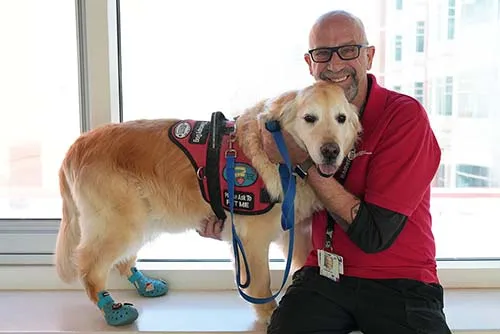
When Eric Hoff and his pet therapy dog, Remy, said goodbye to Denver Health in August after more than a decade of volunteering, he shared a favorite story from their time together: how Remy became known as “the dog who wakes the dead.”
A patient was nearing the end of his life and hadn't shown any neurological response in weeks. Eric set a chair beside the bed so Remy could stand on it and the man's family could guide his hand over Remy's fur.
Inexplicably, Remy twice pushed the chair aside and climbed onto the bed, something he wasn't supposed to do. The second time, the patient's wife asked Eric to let him stay.
Remy nuzzled the man and pushed his nose beneath his chin. The patient opened his eyes.
His family began crying. Staff rushed in from the hallway after hearing the commotion. Doctors later explained it was a neurological response to stimulation, not a recovery, and he died not long after.
But for a moment, Remy made all the difference.
"It just seemed like it was that moment to give the family that one last chance to say goodbye, because everyone was there, everyone was together," Eric said.
Thus, he became Remy, the dog who wakes the dead.
A reason to smile
Twice a week, the Remy and Eric made rounds through nearly every corner of the hospital, bringing comfort, smiles and, if you were lucky, a marshmallow trick.
In August, at nearly 14 years old, Remy retired. Hip dysplasia and severe osteoarthritis hadmade hospital rounds too hard on him.
"I don't think people truly understand the impact that a therapy dog has," Eric said. "I know I certainly didn't when I first started out. I had no idea it would turn into what it turned into."
Eric never set out to make Remy a therapy dog. Remy had lived in five homes in two states during his first six months of life and was abused, Eric said. When Eric adopted him, Remy was terrified of people and would urinate submissively when approached.
It took months for Eric to earn his trust. Once Remy could meet strangers and kids without fear, Eric looked into therapy work to keep that socialization going.
Instead, Remy ended up helping everyone else.
Over 11 years, Remy built relationships throughout Denver Health, but the ACUTE Center for Eating Disorders became something like a second home. Because patients there can stay for weeks at a time, Eric and Remy had time to really get to know them, and patients looked forward to their next visit.
Employees felt it, too. Eric remembers hearing from staff who would perk up when they remembered it was Tuesday and that Remy would be there.
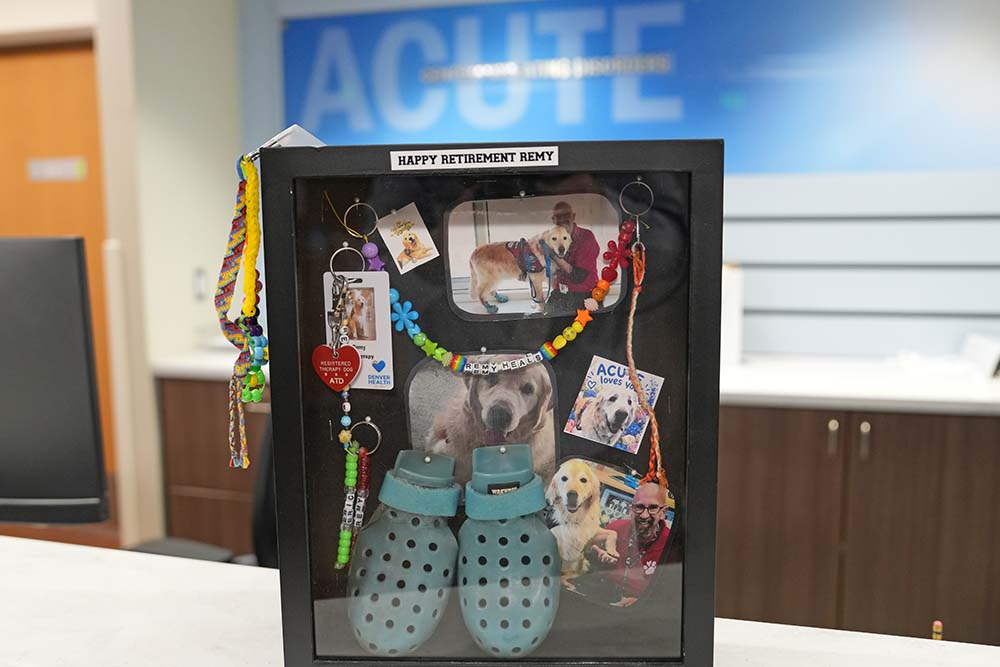
At his retirement party, ACUTE staff gave Eric a journal filled with messages from patients and coworkers. ACUTE added a display case to its walls featuring Remy's ID badge, photos, friendship bracelets patients had made him, and the small Crocs he wore around the hospital.
One former patient wrote that Eric and Remy had "shown a light in my life where there was lots of darkness."
More therapy teams needed
Denver Health Volunteer Services is looking for more volunteer pet therapy teams to keep bringing those moments of comfort to patients, families and staff. Volunteers must maintain certification and yearly registration through the Alliance of Therapy Dogs or Pet Partners. Shifts are available seven days a week.
For anyone on the fence about trying it, Eric encourages them to volunteer.
"I wasn't sure what it was going to be, and it sure took on a life of its own," he said.
Remy is mostly homebound now, unable to go for more than a short walk. Eric said he intends to spoil him with food and comfort in the time they have left.