November 10, 2026
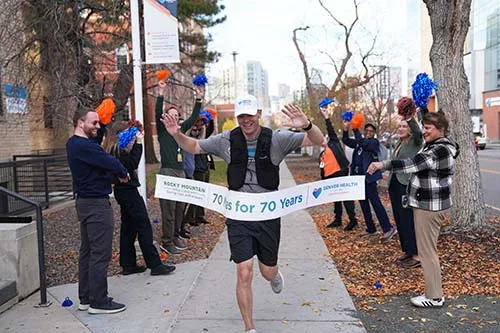
While most of Denver was fast asleep, Brandon Ensign was up and running.
He started at 12:01 a.m. on Oct. 30 and didn’t stop until he’d clocked 70 miles.
Ensign, associate chief operating officer of Denver Health's Rocky Mountain Poison and Drug Safety (RMPDS), wasn't running a sanctioned race or ultramarathon. He was celebrating the department's 70th anniversary with a journey that, as he saw it, honored its past and present.
“Seventy years is a long time, so I wanted to do something that most people would recognize as really difficult, which means it was worthwhile,” said the seasoned runner, whose previous best was 63 miles.
His route took him back and forth along Speer Boulevard between RMPDS's headquarters, 1391 Speer Blvd., and Pavilion I on Denver Health's main campus, where the poison center got its humble start, in a closet in the pediatrics ward, in 1956. The two buildings are about a mile apart.
A history of helping
Ensign came up with the idea while reflecting on the agency's future and the retirement of longtime RMPDS leader Richard Dart, MD, who served for 35 years. Ensign, who has worked for RMPDS for seven years, became curious about the people and places that built the public health leader into what it is today.
His research led him to RMPDS founder Winona Campbell, MD, who developed the concept of a poison center in 1956. With help from historical documents and Denver Health colleagues, he discovered the original building was still standing.
He'd even been inside it without realizing its significance. That discovery inspired him to connect the past and present in a memorable way.
"I like doing hard things," Ensign said.
RMPDS is one of the leading poison centers in the U.S., working to advance public health and improve access to care through teaching, research and its 24/7 poison hotline, 800-222-1222. It is Colorado’s trusted leader for poison information, handling more than 1.5 million cases each year.
The agency has spent 70 years saving lives and shaping the future of poison treatment and prevention, including pioneering care, training generations of toxicologists and advancing research. RMPDS is leading the nation on research of psychedelics and their effects on adults. Psilocybin, the active ingredient in "magic mushrooms," is more popular than ever, according to the National Survey Investigating Hallucinogenic Trends (NSIHT), which is the largest study of its kind in the U.S.
Going the distance
Ensign credits the preventive care he receives at Denver Health with motivating him to become more physically active and take better care of his health. He hopes to tackle an even bigger challenge in December, a 100-mile run.
But first, he faced 70 miles. It was 48 degrees when Ensign took his first step just after midnight. Along the way, colleagues cheered him on, and some joined him for portions of the run.
"At mile 62, I hit my lowest point," Ensign said. "Then, over those final miles, (my colleagues) showed up. They pulled me out of that low and gave me the clarity I needed to finish strong.
"Our organization isn't perfect, but it's full of remarkable people who have each other's backs. We show up when things get tough and the miles get long."
At 5:16 p.m., Ensign crossed his finish line, having run 70.04 miles with a running time of 15 hours, 15 minutes and an average pace of 13 minutes, 4 seconds per mile.
Co-workers cheered him on as he made the final push, and his wife and two children embraced him after the race.
His next step, he said, would be finding food.