November 10, 2026
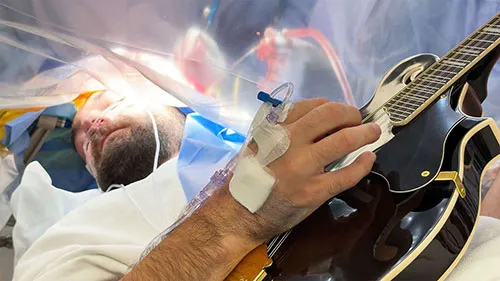
Conner Carver packed for brain surgery like a musician headed to a gig.
He brought his mandolin and a setlist. He'd played at coffee shops, but this would be his first hospital performance.
The 29-year-old lay awake on an operating table at Denver Health, with his skull clamped in place, and played his instrument while neurosurgeons removed a lesion, or abnormal brain tissue, that had been causing epileptic seizures for nearly a decade.
“It put my life on hold for the last 10 years,” he said of his epilepsy. “If there's any chance of seizure freedom, I want to take it.”
A long rest
Carver, of Colorado Springs, began having seizures around age 18. At worst, he said he experienced about 20 nonconvulsive seizures a day and five convulsive seizures a week.
Medication and two implanted devices had eliminated the convulsive seizures and reduced the complex partials to an average of three a month.
But epilepsy still kept him from driving and limited his ability to work and live independently.
“It’s difficult being 29 and having to rely on your parents for most things,” Carver said.
The source of the seizures was a lesion of dysfunctional brain tissue near areas involved with speech and memory.
Fabio Grassia, MD, head of neurosurgery at Denver Health, believed removing it offered Carver his best chance at seizure freedom. But doing so meant making sure surgery didn’t take away abilities Carver wanted to protect.
That included music, which became a refuge for Carver during the years epilepsy kept his life on hold. Unable to work for long stretches and with more free time than he wanted, he turned to instruments to stay busy and keep his spirits up. He had played piano and accordion growing up, then added violin, cello and, eventually, mandolin.
Playing through
During the awake surgery, a speech therapist and neurologist tested Carver as Grassia worked for hours. Carver identified pictures, read, spoke and played tunes including “Ashokan Farewell,” “Danny Boy” and other fiddle and bluegrass music he'd memorized.
If he could still recognize, remember and perform the music, the team had another real-time sign that those important functions remained intact.
It was the first time Denver Health had a patient play an instrument during awake brain surgery. Grassia compared the procedure itself to music.
“It’s like an ensemble, it’s like an orchestra,” he said. “Everybody needs to play this little instrument in the perfect moment, at the right time, so that it comes out as a melody.”
While Carver didn’t feel pain during the operation, because the brain lacks pain receptors, he said it was still challenging to concentrate on music while hearing surgical tools, machines and beeping around him for about four hours, and being asked questions by a speech therapist at the same time.
“It was a little scary at first, but I just wanted to get through it,” he said.
Grassia removed the entire lesion, roughly the size of a couple of grapes.
Carver experienced some difficulty finding words afterward, a side effect of swelling, but it has improved as he recovers. Nearly a month later, he had not experienced another seizure.
And he can still play all his instruments.
Bringing it home
Carver hopes his story helps people better understand epilepsy. He said many people only know seizures from what they have seen in movies or on TV, where they are often portrayed as dramatic, full-body convulsions. In reality, epilepsy can look very different, especially nonconvulsive seizures.
That misunderstanding can make people uncomfortable around someone with epilepsy, Carver said, and he hopes greater awareness will change that.
“I feel like if there's more epilepsy awareness … that maybe it will decrease the scare and the worry people feel around him and others with the condition,” he said.
If recovery goes well, and Carver can live independently, he plans to move back to the family farm in Nebraska, where he can farm and ranch, as he did before his seizures took that life away from him.
After a decade of epilepsy calling the tune, Carver may finally get to write the next verse.