August 06, 2026
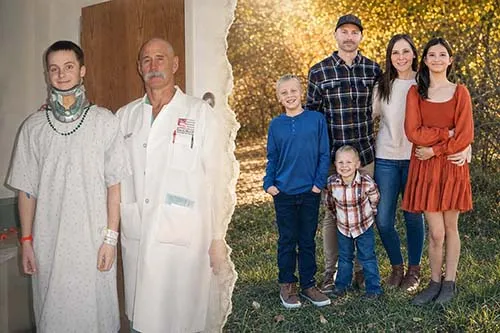
Every March 13, Tyler Oatts heads into the woods. He might hike through Wyoming’s Bighorn National Forest, search for elk sheds or simply spend the day outside. He’s made it a point to do something he loves on the day he nearly lost everything.
It is the day Oatts nearly died and the day Denver Health trauma surgeon Ernest E. Moore, MD, gave him the rest of his life.
Oatts, 34, was 18 when he was accidentally shot in the neck while target shooting with friends in rural Wyoming. He dropped to the ground and immediately knew he was in serious trouble, calling out to his friends, “I’m hit.”
“Looking back now, I realize just how close I came to not having the life I’ve been fortunate enough to live,” Oatts said.
Race against time
One friend called for help. The other pressed a finger into the wound to stop bleeding as they waited for a volunteer ambulance crew.
Oatts was taken first to a hospital in Sheridan. The bullet had damaged his right carotid artery and lodged near his cervical spine. A hospital in Billings, Montana, determined it could not safely handle the injury and called Dr. Moore. He recommended heparin to avoid clots migrating to the brain and immediate air transport. Oatts was flown about 450 miles to Denver Health’s Level I trauma center, and taken directly to the operating room.
In the operating room, Moore discovered extensive damage where the common carotid artery divides into the vessels supplying the brain and face. He tied off the damaged external carotid artery and placed a temporary shunt to keep blood flowing to Oatts’ brain while he rebuilt the internal carotid artery. Moore removed a section of vein from Oatts’ leg and used it as a graft to replace the destroyed artery.
Oatts avoided a stroke, left the hospital six days later and had equal strength in both arms within six weeks. Within two months, he was out of his neck brace. A year later, testing confirmed normal blood flow through the repaired carotid artery.
That fall, just months after the accident, he went elk hunting with a childhood friend who had also been one of the volunteer first responders at the scene on March 13.
When Moore wrote to ask how his recovery was going, Oatts replied with a photograph of himself packing out an elk he had shot with a bow.
Renewed appreciation
More than a decade later, Oatts found a published case report about his injury. Reading the clinical details made him realize how close he had come to losing everything that followed.
He wrote Moore in July to say thank you.
“He’s honestly an angel of a human,” Oatts said. “He is a one-of-a-kind doctor, for sure.”
Moore’s work, Oatts wrote, gave him “decades of experiences, memories, and the opportunity to be a father, mentor, outdoorsman, and friend.”
Moore remembered him well. He remembered meeting Oatts’ mother and sister after surgery and discussing the severity of the injury. He even remembered the photograph of the elk, a shared passion. He congratulated Oatts on his successful career and beautiful family.
“Trauma surgeons often meet patients on the worst day of their lives, and we rarely get to see all the years that follow," Moore said. "Hearing about Tyler’s family, career and adventures is a powerful reminder of why we do this work.”
Today, Oatts lives in Sheridan, Wyoming, with his wife and three children, with another daughter due in September.
He teaches firearm safety seminars, using his own experience to help others become safer, more responsible gun owners.