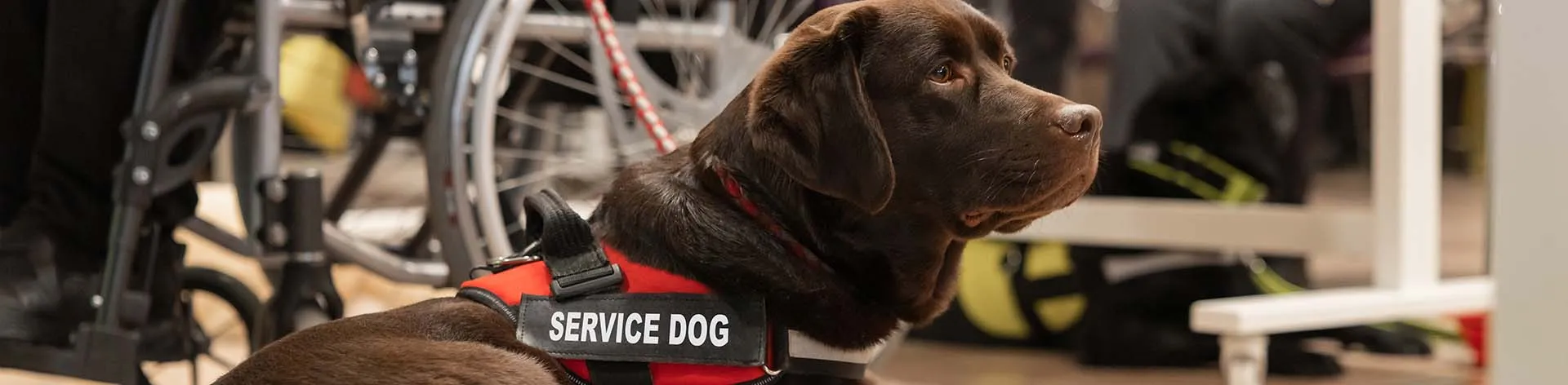
Denver Health welcomes service animals in accordance with the Americans with Disabilities Act (ADA). People with disabilities who use service animals may bring them into all areas of our facilities where the public is normally allowed, including patient rooms, clinics, exam rooms and the cafeteria.
What is a service animal?
A service animal is a dog (or, in some cases, a miniature horse) individually trained to perform a task for a person with a disability, such as guiding someone who is blind, alerting someone who is deaf, or responding to a seizure. Service animals are working animals, not pets.
Emotional support, comfort and companion animals do not meet the ADA definition of a service animal and are not permitted in our facilities.
Handler responsibilities
- Keep the animal harnessed, leashed or tethered, unless this interferes with its task or the handler's disability.
- Maintain control of the animal at all times.
- Provide for the animal's feeding, walking and care. Denver Health staff cannot take on these responsibilities.
When a service animal may be asked to leave?
A service animal may be asked to leave if it is out of control and the handler doesn't correct the behavior, or if it poses a direct threat to health or safety. Allergies or fear of animals are not valid reasons to deny access; Denver Health will instead make other accommodations.
Where service animals may not be allowed?
For infection control and safety, service animals are generally restricted from areas such as operating rooms, intensive care units, isolation rooms and the dialysis and infusion units.
Contact
Contact Denver Health Security at 303-436-7444 for more information or to request accommodations.
Frequently Asked Questions: Service Animals
What is a service animal?
A service animal is a dog, or in some cases a miniature horse, individually trained to perform a task for a person with a disability. Examples include guiding someone who is blind, alerting someone who is deaf or responding to a seizure. Service animals are working animals, not pets.
Can I bring my emotional support or comfort animal?
No. Emotional support, comfort and companion animals do not meet the ADA's definition of a service animal, so they are not permitted in Denver Health facilities.
Where can I bring my service animal?
Your service animal may go anywhere in our facilities that the public is normally allowed, including patient rooms, clinics, exam rooms and the cafeteria.
Will staff ask me questions about my service animal?
If it isn't obvious that an animal is a service animal, staff may ask only two questions: whether the animal is required because of a disability, and what task it's trained to perform. Staff won't ask about your disability or request the animal to demonstrate its task.
Do I need to show ID or paperwork for my service animal?
No. Staff cannot require documentation, a special ID card or proof of training. The one exception is proof of rabies vaccination, which staff may ask for but you aren't required to provide.
Who is responsible for my service animal's care while I'm here?
You, or someone you designate, are responsible for feeding, walking and caring for your service animal. Denver Health staff cannot take on this responsibility.
Are there any areas where service animals aren't allowed?
Yes. For infection control and safety, service animals are generally restricted from areas such as operating rooms, intensive care units, isolation rooms, and the dialysis and infusion units.
Can a service animal ever be asked to leave?
Yes, if it is out of control and the handler doesn't correct the behavior, or if it poses a direct threat to health or safety. Allergies or a fear of animals are not valid reasons to deny access. We'll make other accommodations instead.